

Why Your Iconic Might Be Worth $600 or $2,000 (And How to Know Which)
2/27/20267 min read
The $600 Question: What Should an Iconic Actually Cost?
Since Ravensburger introduced the Iconic rarity with Fabled in 2025, the Lorcana community has been wrestling with a fascinating question: what's the "right" price for a card so rare that most players will never pull one?
At 1-in-1,500 packs (estimate), Iconics exist in a pricing twilight zone between "chase card" and "investment piece." They're too rare to be tournament staples, too expensive to be casual purchases, and too new to have established historical precedent. So let's ignore what they're actually selling for and ask a more interesting question: what should they cost?
Let's build a theoretical framework from the ground up.
The Rarity Math: How Rare Is "Iconic"?
Before we can price something, we need to understand exactly what we're pricing.
The Pull Rate: 1 in 1,500 packs
Packs per box: 24
Boxes to statistically pull one Iconic: 62.5
That's the baseline. But here's where it gets interesting: pull rates describe averages, not guarantees. The actual distribution follows probability curves that look something like this:
50% of players will pull an Iconic within 43 boxes (~$4,300-6,450)
90% of players will pull an Iconic within 140 boxes (~$14,000-21,000)
Some unlucky souls will crack 200+ boxes and whiff completely
Already we can see the problem: the "expected value" of opening boxes hunting for Iconics is a terrible bet. But that doesn't tell us what they should cost—it just tells us what it costs to gamble for them.
Approach #1: The Enchanted Multiplier Theory
Let's start with what we know: Enchanted pricing.
Enchanteds pull at 1-in-96 packs (4 boxes). Top-tier competitive Enchanteds tend to settle around $150-250 once supply stabilizes. These are cards that see actual tournament play, have high transaction volume, and serve dual purposes as both playable and collectible.
The rarity gap: Iconics are 15.6x rarer than Enchanteds (1,500 ÷ 96 = 15.625)
If we apply a straight multiplier to a $200 Enchanted, we get:
$200 × 15.6 = $3,120
But wait—that can't be right. We're assuming rarity scales linearly with value, which it absolutely does not.
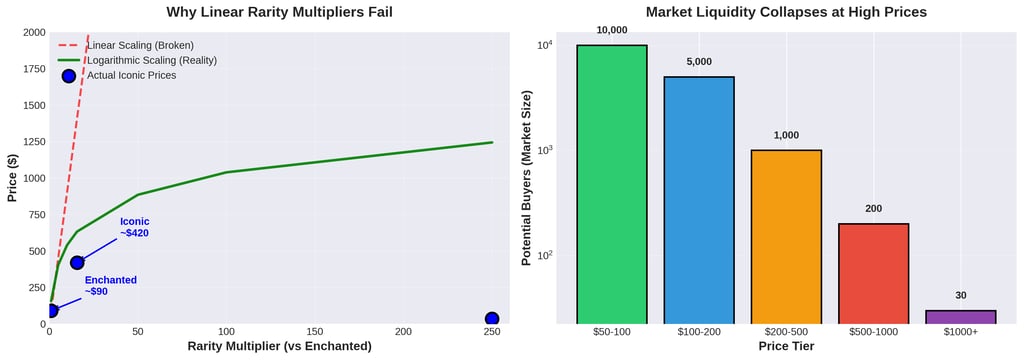
The chart shows why linear scaling breaks: actual Iconic prices follow a logarithmic curve (green), not a linear one (red). Markets don't value scarcity in straight lines—they value it on curves.
The market for $3,000 cards is microscopic compared to $200 cards. Fewer buyers means less liquidity, which caps prices regardless of rarity.
Let's try a different model.
Approach #2: The Collector Premium Model
Here's a better framework: cards have a base utility value plus a collector premium.
Base utility value = competitive playability
Collector premium = scarcity × desirability × completionist demand
For Iconics, the base utility value is near-zero. Why? Because every Iconic has a Legendary version with identical gameplay in the same set. Competitive players will never pay the Iconic premium when the $20-40 Legendary does the exact same thing.
So Iconics are pure collector premium. The entire price is psychological, not functional.
What drives that premium?
Scarcity - How rare is it? ✓ Maximum (1 in 1,500 packs)
Completability - Can I realistically own this? Borderline (62.5 boxes = $6,750-9,375)
Display value - Does it look amazing? ✓ Yes (full art, premium foiling)
IP strength - Mickey or a side character? Varies wildly
Historical significance - First villain Iconic, etc.? Sometimes
The price ceiling: An "ideal" Iconic (Disney Princess, first-ever, exceptional art) might justify $800-1,200 to completionist collectors.
The floor: A weak-IP Iconic with no significance might struggle to hold $300-400.
The average: Most "good but not exceptional" Iconics probably settle around $500-700.
Approach #3: The Opportunity Cost Model
Let's flip the question: what would you pay to avoid opening 62.5 boxes?
Cost to self-pull an Iconic:
62.5 boxes at retail ($144/box) = $9,000
62.5 boxes at market ($100-120/box) = $6,250-7,500
But opening boxes gives you everything else too:
~250 Legendaries (avg $5 each) = $1,250
~15 Enchanteds (avg $80 each) = $1,200
Bulk/foils = $500
Total byproduct value: ~$2,950
The real cost of the Iconic:
$7,000 (boxes) - $3,000 (other cards) = $4,000
But here's the paradox: if Iconics cost $4,000, nobody would open boxes—they'd just buy singles. And if nobody opens boxes, supply dries up and prices go UP.
The equilibrium sits where buyers are indifferent between:
Buying the single at market price
Gambling on boxes to pull it
Given human psychology (we overvalue gambling and rare pulls), equilibrium probably lands around:
$600-900 for average Iconics
$1,200-1,800 for exceptional ones
Approach #4: The Comparison Shopping Model
Let's look outside Lorcana for a moment.
Magic: The Gathering has ultra-rare "Serialized" variants at similar pull rates (1-in-1,500):
Mediocre cards: $500-1,000
Strong playables: $2,000-5,000
But Magic has 30 years of collector culture and millions more players
Pokémon has ultra-rares in the 1-in-500 to 1-in-1,000 range:
Mediocre pulls: $200-400
Popular characters (Charizard, Pikachu): $800-2,000
Again, Pokémon's collector base dwarfs Lorcana's
What this tells us:
Lorcana Iconics should price between Pokémon and Magic ultra-rares, adjusted down for smaller market size.
Realistic range: $400-1,000 for standard Iconics
Ceiling for exceptional cards: $1,500-2,000
Approach #5: The Substitution Effect
Here's a critical question: what else could you buy with that money?
At $500, an Iconic competes with a complete playset of every Legendary in a set, 15-20 top Enchanteds, or multiple booster boxes.
At $1,500, an Iconic competes with a complete Enchanted collection from multiple sets, high-end graded cards, or significant real-world purchases.
Buyer psychology: Casual collectors cap out around $300-500 for any single card. Serious collectors might stretch to $1,000. Beyond that, you're selling to whales—a tiny market.
The natural ceiling: $600-800 for most Iconics, $1,200-1,800 for absolute chase cards.
Approach #6: Supply & Demand Equilibrium
How many Iconics exist?
If a set has 10 million packs printed: ~6,667 total Iconics (÷ 1,500 pull rate)
Divided across 2 Iconics per set: ~3,333 of each card
But not all hit the market:
Some stay sealed forever
Some get pulled and kept
Estimate: 30-40% reach secondary market = ~1,000-1,300 copies available
At different price points:
$500: High demand, thousands of buyers → market clears fast
$1,500: Low demand, dozens of buyers → market moves slowly
The market-clearing price (where supply meets demand):
$450-650 for weak-IP Iconics
$700-1,000 for strong-IP Iconics
$1,200-1,500 for perfect-storm chase cards
The Stabilization Timeline
Here's where theory meets reality: Iconic prices won't stabilize immediately.
Week 1 (Prerelease): Pure chaos. First copies command absurd premiums ($1,000-2,000+) from must-have-it-first collectors. No supply, maximum FOMO.
Weeks 2-4 (Supply shock): Boxes flood the market. Iconics start appearing. Prices crash from week-1 highs as supply increases 100x. Panic sellers compete.
Months 2-3 (Discovery): Market learns if the card is playable (spoiler: it's not, the Legendary exists). Competitive premium evaporates. Price is now pure collector demand.
Months 4-6 (Stabilization): Box openings slow dramatically. Supply dwindles to a trickle. Remaining supply finds its natural price level based on collector demand.
Year 1+: Price moves based on meta shifts (does the Legendary version become format-defining?), nostalgia waves (Disney movie releases), and rotation announcements.
Theoretical stable price reached: 4-6 months post-release
At that point, we'd expect:
Tier 1 Iconics (Princess, A-tier villain, historical significance): $800-1,200
Tier 2 Iconics (Good IP, solid art, no special significance): $500-700
Tier 3 Iconics (Weak IP, forgettable, poor timing): $350-450
The Psychological Price Anchors
Humans are terrible at valuing rare items in a vacuum. We need reference points.
Anchoring effect: If the first Iconic sold for $2,000, all future Iconics anchor to that number—even if it was irrational. Conversely, if early Iconics "only" hit $400, that becomes the mental ceiling.
Round number bias: Prices cluster around $500, $750, $1,000, etc. You'll rarely see an Iconic settle at $847.
Prestige pricing: Some collectors interpret "more expensive" as "more desirable" even when scarcity is identical. A $1,200 Iconic feels more prestigious than a $500 one, which can become self-fulfilling.
What this means: Early Iconic pricing sets the trajectory for all future Iconics. If Ravensburger wants Iconics to be $1,000+ cards, they need to manage initial supply very carefully and let week-1 prices stay sky-high. If they want accessible $400-500 Iconics, they need to flood supply early.
The Theoretical "Fair" Price
After running six different valuation models, here's where the math converges:
For a "standard" Iconic (good IP, solid art, no special significance, high supply):
Conservative estimate: $350-450
Moderate estimate: $450-600
Optimistic estimate: $600-800
For an "exceptional" Iconic (Princess or A-tier villain, milestone card, exceptional art, high supply):
Conservative estimate: $650-850
Moderate estimate: $850-1,100
Optimistic estimate: $1,100-1,400
For a "weak" Iconic (C-tier character, poor timing, unremarkable art):
Conservative estimate: $200-300
Moderate estimate: $300-400
Optimistic estimate: $400-500
Supply adjustment: For sets with low supply (< 500 boxes sold in 3 months), add a 1.5-1.8x multiplier to all above ranges. This explains why Fabled Iconics trade at $800-1,500 while Whispers Iconics settle around $400-450.
The "fair" price—where supply meets demand in a rational market—depends heavily on both IP strength AND set availability. A strong IP Iconic in a heavily-opened set might be $600. The same card in a low-supply set could be $900-1,000.
But Theory Isn't Reality
Here's the kicker: markets aren't rational.
Iconics might trade at $2,000 because:
Whales FOMO into early copies
Supply gets hoarded by investors
A movie release creates artificial demand
The meta shifts and the Legendary version becomes essential (halo effect)
Or they might crash to $300 because:
Players realize the Legendary version is identical
Too many boxes get opened (oversupply)
The economy tanks and luxury purchases evaporate
The character/franchise has zero nostalgia pull
The "right" price for an Iconic is whatever the market will bear on any given day. But if forced to pick a number that balances rarity, collector psychology, market liquidity, opportunity cost, AND supply availability?
For high-supply sets: $500-700 feels like the Goldilocks zone for most Iconics.
For low-supply sets: $800-1,500 reflects the scarcity premium.
Not so cheap that they lose prestige. Not so expensive that only whales can play. Rare enough to feel special. Attainable enough that completionists can justify the stretch.
The Real Question
The more interesting question isn't "what should Iconics cost?"—it's "what do Iconics DO for Lorcana?"
They give whales something to chase. They create social media moments. They add mystique to the rarity structure. They let Ravensburger print absolutely stunning premium cards without worrying about competitive balance (since Legendaries exist).
From that lens, the "right" price is whatever keeps whales engaged without alienating the broader player base. Too cheap, and whales lose interest (no flex value). Too expensive, and everyone else feels priced out (resentment builds).
The sweet spot? Probably where Iconics naturally settle once the market matures.
And based on pure theory—divorced from actual sales—that's somewhere in the $500-900 range for most cards, with outliers reaching $1,500+ or dipping to $300-.
Time will tell if reality agrees with the math.
Want to see how these theoretical models match up against real market data? Check out our Complete Whispers in the Well Price Guide for actual three-month pricing trends on every Iconic, Enchanted, and Legendary in the set.